Neither a hydrogel nor an ointment is better for every wound: hydrogels add moisture and suit dry or lightly draining wounds, while ointments seal moisture in and suit small, shallow scrapes. How wet the wound already is, and how sensitive your skin is, usually decides which one fits.
What were traditional ointments designed to do?
Ointments are oil-based products, often petrolatum, that form a protective layer over the skin.
For decades they have been the default first aid choice for cuts, scrapes and minor burns. Their main jobs are simple:
- Create a barrier over the wound surface.
- Reduce moisture loss so the wound doesn't dry into a hard scab.
- Stop the bandage sticking to the wound.
Some ointments also contain antibiotics or other active ingredients. Those are a separate category and are best used on a provider's or pharmacist's advice.
Where do ointments fall short?
Ointments hold moisture in but cannot add it, and they do not adjust to how wet the wound is.
- On moist wounds, sealing in fluid can soften and whiten the surrounding skin.
- Under bandages and socks, a thick greasy layer can trap heat and sweat.
- On sensitive skin, some ointment ingredients, especially in medicated products, can cause irritation or allergy.
- On larger areas, they can be messy and transfer to clothing.
How do hydrogels work differently?
Hydrogels are water-based gels that release moisture into the wound rather than only sealing it in.
- Moisture donation: they hydrate a dry wound bed, which supports the moist environment new skin cells need to move across the wound.
- Cooling feel: evaporation from the gel makes them feel cool on scrapes and superficial burns.
- Non-greasy: they are light, wash off easily and are often better tolerated by sensitive skin.
- Gentle dressing changes: the gel layer keeps bandages from sticking.
Hydrogels have limits too. They absorb very little, so they are not suited to heavily draining wounds, and amorphous gels need a bandage to stay in place. For a closer look at the mechanism, see how a wound hydrogel works.
Which should you use for common wounds?
Match the product to how wet the wound is and where it is.
- Small, shallow cut or scrape: either works. A thin layer of plain ointment or a hydrogel under a bandage both keep it moist.
- Large abrasion or road rash: a hydrogel spreads easily and stays comfortable over a wide area. See road rash first aid.
- Minor superficial burn: after cooling under running water, a hydrogel's cooling feel is often preferred. Avoid butter and greasy home remedies.
- Wound that is already weeping: neither; an absorbent dressing is usually better.
- Very dry, intact skin around a healed wound: a thicker emollient or barrier cream suits intact skin.
- Deep, infected or non-healing wound: see a provider before applying anything.
What about diabetic or fragile skin?
Fragile, dry or diabetic skin often does better with lighter, fragrance-free, non-occlusive products, which is why hydrogels are frequently considered. Diabetic wounds also need a provider's input. We cover this in detail in ointment vs. gel for diabetic wounds.
What are bioactive hydrogels?
Some hydrogels include botanical or other ingredients chosen to support the skin around the wound or add comfort, beyond simply providing moisture. Ingredients and evidence vary widely between products. See what bioactive ingredients are in wound care.
The bottom line
Ointments are a simple, familiar way to keep a small wound from drying out. Hydrogels add moisture, feel lighter and are often a better match for dry wounds, larger scrapes, superficial burns and sensitive skin. Whichever you choose, keep the wound clean and covered, and get any wound that is deep, infected or not improving checked by a provider. For why moisture matters at all, read the science behind moist wound healing.
How Lavior's Multipurpose Wound Gel fits in
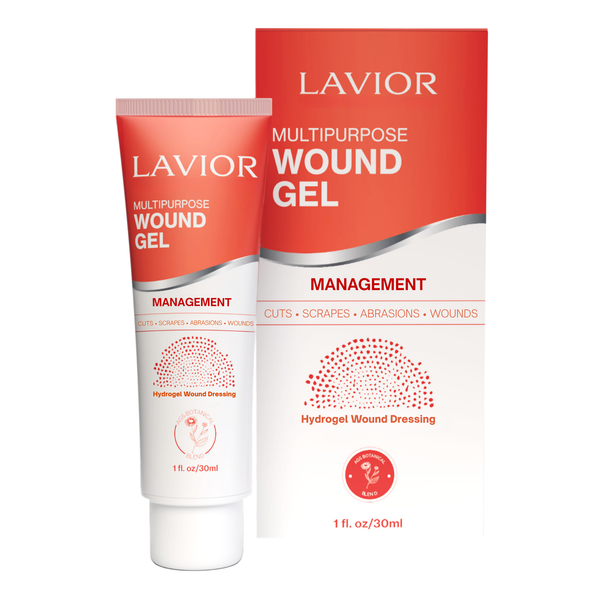
Lavior Multipurpose Wound Gel is a non-greasy hydrogel with aloe vera and Inula AGS-RIED (Lavior's proprietary extract of Inula viscosa). Lavior™ Multipurpose Wound Gel helps maintain a moist wound environment when used for the indications described on its label. Follow the product instructions and your healthcare professional's wound care plan. It is fragrance-free and suitable for sensitive skin. Apply a thin layer under a non-stick bandage as directed.
Sources
- Winter GD. Formation of the scab and the rate of epithelization of superficial wounds in the skin of the young domestic pig. Nature. 1962;193:293–294. doi:10.1038/193293a0
- Schultz GS, et al. Wound bed preparation: a systematic approach to wound management. Wound Repair Regen. 2003;11(Suppl 1):S1–S28. doi:10.1046/j.1524-475X.11.s2.1.x