Inula viscosa, also known by its botanical name Dittrichia viscosa, is a sticky-leaved Mediterranean plant from the daisy family that has been used on skin in folk medicine for generations. Inula AGS-RIED™ is Lavior's proprietary, selectively bred strain of the plant and the botanical ingredient in Lavior's wound gels and skin barrier products.
This page explains what the plant is, how it has traditionally been used, what laboratory research has found, why Lavior grows its own strain, and what has been studied in people. For a shorter look at common claims about the plant, see What Is Inula, and What Does Research Say About It for Skin?
Inula AGS-RIED at a glance
- Plant: Inula viscosa (L.) Aiton, also classified as Dittrichia viscosa (L.) Greuter. Daisy family (Asteraceae).
- Common names: sticky fleabane, false yellowhead, woody fleabane.
- Native range: the Mediterranean basin, where it grows wild along roadsides, fields and coasts.
- Traditional use: crushed fresh leaves applied to wounds, burns, bruises and skin complaints in Mediterranean folk medicine.
- Key compounds: flavonoids, phenolic acids (including caffeoylquinic acids), sesquiterpene lactones (such as inuviscolide and tomentosin) and terpenoids.
- Inula AGS-RIED: a cultivated strain developed by Lavior through generations of selective breeding for bioactive content.
- In people: a randomized controlled trial of Lavior's Inula viscosa hydrogel in diabetic foot wounds was published in the Journal of Wound Care in 2025.
- Patent: international (PCT) patent application WO2026025077A1, "Hydrogel formulations containing Inula viscosa extract for wound care."
What is Inula viscosa?
Inula viscosa is a hardy perennial shrub from the daisy family that grows throughout the Mediterranean. Its leaves are covered in tiny glandular hairs that make them sticky to the touch, which is where the name viscosa ("sticky") comes from.
It produces small yellow flowers in late summer and autumn. Botanists have classified the plant in two ways over the years, so it appears in research under both Inula viscosa and Dittrichia viscosa. They are the same species.
How has Inula viscosa been used on skin?
Across the Mediterranean, Inula viscosa has been part of traditional herbal medicine for generations, mostly applied directly to the skin. In Morocco, fresh leaves are traditionally crushed and applied to burns, wounds and infections [1]. Elsewhere in the Mediterranean it is used for bruises and skin disorders [2].
A 2024 review of the published research found a strong match between these traditional uses and the plant's measured biological activity in the lab [3]. Traditional use alone does not show that a plant works, but it is often where research starts.
What is in the plant?
Researchers have identified a rich mix of plant compounds in Inula viscosa leaves [3, 4]:
- Flavonoids such as rhamnocitrin and sakuranetin
- Phenolic acids, including caffeoylquinic acids, which give the extract much of its antioxidant capacity
- Sesquiterpene lactones such as inuviscolide and tomentosin
- Terpenoids that make up much of its aromatic oil
What has laboratory research found?
Most published research on Inula viscosa is preclinical, meaning experiments in the lab and in animals. These studies help explain why the plant has been used on skin, but they do not show that any product will have the same effect in people.
- Inflammation: compounds isolated from the leaves reduced skin inflammation when applied to the skin in mouse models [5, 6].
- Antioxidant activity: leaf extracts and ointments made from them show strong antioxidant activity, linked mainly to their caffeoylquinic acids [2].
- Wound models: in mice, ointments containing the leaf extract were associated with near-complete wound closure and good skin regeneration over 12 days [2]. In rat burn models, ointments containing the plant were associated with greater wound contraction than controls [1, 7].
- Microbes: extracts have shown activity against several bacteria and fungi in laboratory tests [1, 3].
Why does Lavior grow its own strain?
Wild Inula viscosa is not uniform, so Lavior grows a selectively bred strain to start every batch from the same source material. A 2026 review found that the plant's chemical makeup varies with where it grows, which part of the plant is used, when it is harvested and how it is extracted [4].
Lavior's founder first came across the plant while researching natural approaches to wound care in college. Starting from the wild species, Lavior selected and cross-bred generations of plants with the highest bioactive content, producing a cultivated strain rich in flavonoids, phenolic compounds and antioxidants. Inula AGS-RIED is the result of that conventional selective breeding, not genetic engineering.
Has Inula viscosa been studied in people?
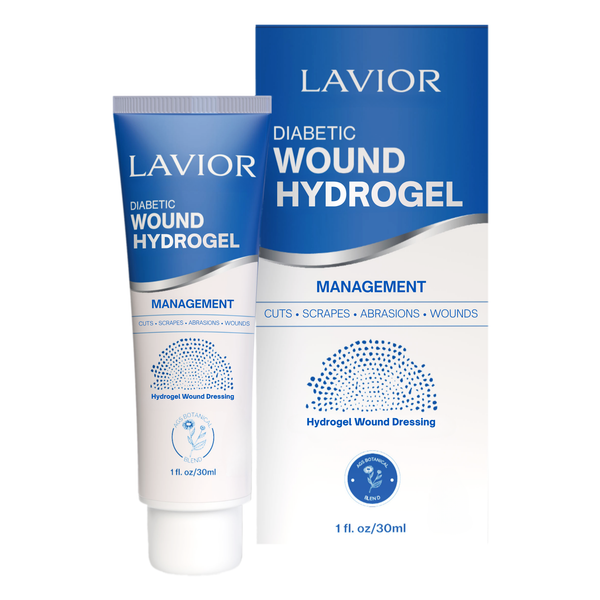
Yes. Lavior's Inula viscosa hydrogel, now sold as Diabetic Wound Hydrogel, was evaluated in a double-blinded randomized controlled trial published in the Journal of Wound Care in 2025 [8]. The study followed 65 patients with diabetic foot wounds for six weeks and compared the Lavior hydrogel with a widely used standard hydrogel:
- Non-inferiority: wound outcomes with the Lavior hydrogel were at least as good as with the standard hydrogel.
- Pain: pain reduction was significantly greater with the Lavior hydrogel in weeks 1 to 4.
- Quality of life: scores on the Diabetic Foot Scale improved significantly more with the Lavior hydrogel.
- Wound area: wound area fell more with the Lavior hydrogel, but that difference was not statistically significant, and closure times were comparable.
Read the full study summary. A separate pilot study in 14 people with diabetes evaluated a cream containing Inula viscosa extract for dry skin [9].
Is Inula viscosa safe on skin?
Most people tolerate it, but like other daisy-family plants it can cause sensitivity in some people: allergic skin reactions to contact with the fresh, wild plant have been reported [10]. If you have known allergies to daisy-family plants, try a small amount first and stop if irritation occurs.
Lavior products are made without steroids, cortisone, parabens or added fragrance, and are manufactured in the USA in cGMP-certified facilities. They are wound dressings and skin care, not antibiotics. A wound that is not improving, or shows signs of infection, should be seen by a healthcare provider, especially if you have diabetes.
Where will you find Inula AGS-RIED?
Inula AGS-RIED is the botanical ingredient in Lavior's Diabetic Wound Hydrogel, Multipurpose Wound Gel, Post-Surgical Skin Barrier Gel and Diabetic Skin Barrier Cream. To see how it fits into a wider plant-based approach, read What Is Botanical Wound Care?
References
- Bentarhlia N, et al. Fitoterapia. 2024;172:105707. doi:10.1016/j.fitote.2023.105707
- Rhimi W, et al. Dittrichia viscosa L. ethanolic extract based ointment with antiradical, antioxidant, and healing wound activities. Biomed Res Int. 2019;2019:4081253. doi:10.1155/2019/4081253
- Jerada R, et al. A comprehensive review on ethnomedicinal uses, phytochemistry, toxicology, and pharmacological activities of Dittrichia viscosa (L.) Greuter. J Tradit Complement Med. 2024;14(4):355–380. doi:10.1016/j.jtcme.2024.03.012
- Ghidoli M, et al. Volatile organic compounds and beyond: chemical diversity and biological activities of Dittrichia viscosa. Molecules. 2026;31(14):2474. doi:10.3390/molecules31142474
- Máñez S, et al. A glycosyl analogue of diacylglycerol and other antiinflammatory constituents from Inula viscosa. J Nat Prod. 1999;62(4):601–604. doi:10.1021/np980132u
- Hernández V, et al. Effects of naturally occurring dihydroflavonols from Inula viscosa on inflammation and enzymes involved in the arachidonic acid metabolism. Life Sci. 2007;81(6):480–488. doi:10.1016/j.lfs.2007.06.006
- Mssillou I, et al. Ointment-based combination of Dittrichia viscosa L. and Marrubium vulgare L. accelerate burn wound healing. Pharmaceuticals. 2022;15(3):289. doi:10.3390/ph15030289
- Bae SHS, Cole W, Davis IM, Sandler D, Warren JD, Mackenzie JS. Healing wounds with a multimodal botanical hydrogel: a clinical outcomes comparison study. J Wound Care. 2025;34(Sup7):S5–S12. doi:10.12968/jowc.2025.0185
- Cole W, et al. Promoting diabetic skin health in an urban podiatry clinic through a patient activation programme incorporating a botanically enhanced cream. J Lower Limb Wound Care. 2025;1(1):1–7. doi:10.12968/llwc.2025.0001
- Gonçalo M, Gonçalo S. Allergic contact dermatitis from Dittrichia viscosa (L.) Greuter. Contact Dermatitis. 1991;24(1):40–44. doi:10.1111/j.1600-0536.1991.tb01628.x