Most diabetes-related amputations begin with a foot wound, often a small ulcer, that does not heal and becomes seriously infected or loses its blood supply. Nerve damage hides the wound, poor circulation slows healing, and delays in care give infection time to spread.
Amputation is often imagined as a sudden, rare event. In reality, it is usually the end of a longer process that starts with something minor, which is also why there are many chances to change the outcome along the way.
Why do people with diabetes get amputations?
Amputation becomes necessary when tissue in the foot or leg is too badly damaged by infection or lack of blood flow to recover, and removing it is the safest way to protect the rest of the limb and the person's health. With diabetes, three problems usually combine to get there:
- Neuropathy: loss of feeling means a blister, cut or pressure sore may not be noticed until it is advanced.
- Peripheral artery disease (PAD): narrowed arteries reduce the blood, oxygen and immune cells that reach the wound, slowing healing and making infection harder to control.
- Infection: an open wound on the foot can become infected, and infection can spread into deeper tissue and bone (osteomyelitis).
How does a small wound become a chronic one?
Normal wounds move through overlapping stages: stopping bleeding, inflammation, rebuilding new tissue, and remodeling. Chronic wounds, including many diabetic foot ulcers, tend to stall in the inflammatory stage. Instead of rebuilding, the tissue keeps breaking down, often because of ongoing pressure, poor blood flow, infection or bacterial biofilm.
Signs that a wound is not on track include no clear improvement over a couple of weeks, a wound bed that stays pale, dark or covered in yellow tissue, increasing drainage, odor, or redness spreading around it. For a full overview, read what a diabetic foot ulcer is.
What raises the risk of amputation?
- A foot ulcer that has been open for a long time or keeps coming back. See why diabetic foot ulcers return after healing.
- Infection, especially if it reaches bone.
- Significant PAD or gangrene.
- Delayed care, often because the wound did not hurt or access to specialists was limited.
- Smoking, kidney disease and blood glucose that is hard to keep in range.
- A previous amputation.
Outcomes are also not equal across communities. Research has found higher major amputation risk among Black, Hispanic and Native American patients with diabetic foot infections. Consistent daily foot care matters for everyone; see a complete diabetic foot care routine.
How can people with diabetes lower their risk?
Many diabetes-related amputations are considered preventable with early attention. The most important steps are:
- Check your feet every day, including the soles and between the toes.
- Act on small problems quickly. Show any blister, cut, callus with a dark spot, or color change to a healthcare provider rather than waiting.
- Take pressure off any wound. Walking on an ulcer is one of the main reasons it stalls. Your care team may recommend a boot, cast or special shoe; see offloading devices explained.
- Get circulation checked if you have cold feet, leg pain when walking, or slow-healing wounds.
- Work with your care team on blood glucose, blood pressure, cholesterol and quitting smoking.
- Have a foot exam at least once a year, and more often if you have neuropathy, PAD or a past ulcer.
- Ask for a referral to a podiatrist or wound care clinic if a wound is not improving.
When should you seek urgent care?
Seek same-day care if a foot wound shows spreading redness, warmth or swelling, pus or a foul smell, black tissue, new pain in a foot that is usually numb, or if you have fever or chills. These can be signs of a serious infection.
How Lavior's Diabetic Wound Hydrogel fits in
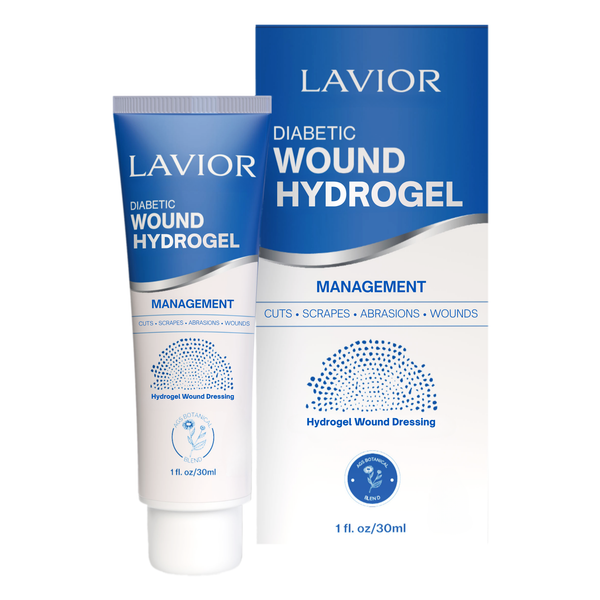
Lavior™ Diabetic Wound Hydrogel helps maintain a moist wound environment when used for the indications described on its label. Follow the product instructions and your healthcare professional's wound care plan. Like every Lavior formula, it is built around Inula AGS-RIED, Lavior's proprietary extract of the Mediterranean plant Inula viscosa. It is intended to be used as part of a care plan from a healthcare provider, not as a replacement for offloading, infection management or professional wound care.
Sources
- Armstrong DG, Boulton AJM, Bus SA. Diabetic foot ulcers and their recurrence. N Engl J Med. 2017;376(24):2367–2375. doi:10.1056/NEJMra1615439
- Schaper NC, et al. Practical guidelines on the prevention and management of diabetes-related foot disease (IWGDF 2023 update). Diabetes Metab Res Rev. 2024;40(3):e3657. doi:10.1002/dmrr.3657
- American Diabetes Association Professional Practice Committee. 12. Retinopathy, neuropathy, and foot care: Standards of Care in Diabetes—2025. Diabetes Care. 2025;48(Suppl 1):S252–S265. doi:10.2337/dc25-S012